
I still remember when “playing games for a living” got you the same look as saying you wanted to be a professional napper. Parents sighed, teachers rolled their eyes, and the idea of strangers watching you play was just weird.
Now? Gaming is bigger than movies and music in raw revenue terms, kids say they want to be streamers the way my generation said astronaut, and a 19-year-old with a good webcam can out-earn a lot of corporate managers.
But it’s not all glory and sponsor deals. For every creator who makes it, there are thousands who quietly stopped uploading. Let’s talk about all of it: how we got here, where it’s going, who’s winning, and who’s getting burned.
How it all started
The arcade and living-room era. Gaming was social from day one. Arcades had high-score boards, and if you were good, everyone in the neighborhood knew your initials. Then consoles moved gaming into living rooms, and friends crowded around one TV, passing the controller.
LAN parties and the first “pro” scenes. In the late ’90s and 2000s, people lugged heavy CRT monitors to each other’s houses to play Counter-Strike, StarCraft and Quake. South Korea took it furthest: StarCraft was on national TV, pro players had fan clubs, and gaming had real cultural weight there long before the West caught on.
Then came the internet’s two big gifts:
- Broadband, which made online play smooth.
- Video platforms such as YouTube (2005) and Twitch (2011, spun out of Justin.tv), which let anyone broadcast to the world.
Suddenly you didn’t need a TV network. You needed a PC and something interesting to say.
The rise: when playing became a career
A few things collided and made the boom.
Watching someone else play turned out to be oddly addictive. Part of it is the skill, part of it is the personality, and part of it is the feeling of hanging out with someone. Streaming became the new talk show, only chattier and less scripted.
Leagues, franchises, prize pools, sponsors, stadiums. The International (Dota 2) famously crowd-funded prize pools past $30 million, and Fortnite's World Cup handed a teenager millions. Titles like League of Legends, Valorant, Counter-Strike, Dota 2 and Mobile Legends built global audiences that sell out arenas.
This one gets underrated. In many countries, including much of South and Southeast Asia, Africa and Latin America, a decent phone is the gaming device. Free Fire, PUBG Mobile, Mobile Legends and Call of Duty Mobile brought hundreds of millions of people in who never owned a console.
Lockdowns put everyone at home, and gaming and streaming numbers went through the roof. Games became where people hung out when they couldn't hang out anywhere else.
The fall (or at least, the hangover)
If you’ve been following the scene, you know the party slowed down. Here’s what happened.
Once people went outside again, viewership and growth cooled. Companies that had hired like crazy during the boom started laying people off, and the games industry has had wave after wave of layoffs and studio closures since.
Many teams were burning money on the assumption that investors would keep funding them. A lot of orgs folded, merged or downsized once the money tightened. Some leagues struggled to turn viewers into actual revenue, because watching a match for free doesn't pay anyone's salary.
Streaming 8 to 10 hours a day, chasing algorithms, responding to chat, staying "on" all the time: it chews people up. Plenty of well-known creators have openly walked away or taken long breaks, saying the grind was ruining their health and their love for the game.
Creators build their whole income on a platform they don't control. Policy changes, revenue split changes, algorithm changes, bans: one update can cut your income in half overnight. Many creators have learned the hard way not to put everything in one basket.
In 2012, being a gaming streamer made you rare. Now there are millions, and standing out is brutally hard.

What's happening right now
Short-form is king for discovery. TikTok, YouTube Shorts and Instagram Reels are where most new audiences find creators. The pattern many follow: clip the best 30 seconds, go viral, then pull people into longer videos or streams where the real loyalty gets built.
Gaming creators are becoming “lifestyle” creators. The most successful ones aren’t just “good at game X.” They have a personality, a storyline, a community, and often a second or third content lane: vlogs, challenges, podcasts, reaction content, even non-gaming stuff.
Esports is leaning on big events and big money. Major tournaments are still huge, and some regions, especially the Middle East, have been pouring serious money into events and prize pools. Meanwhile smaller orgs are focused on being sustainable rather than flashy.
User-generated content platforms are a creator economy of their own. Roblox, Fortnite’s creative tools and Minecraft let people build games inside games, and some creators and studios earn real money from it. Kids are becoming developers without knowing it.
Cloud gaming and handheld PCs (think Steam Deck-style devices) are blurring the lines between console, PC and mobile. You can play a serious game on a handheld, on your phone through the cloud, or on a TV, whichever suits you.
AI is in everything. More on that below, because it’s a big deal.
What people actually do
Not everyone is chasing a million subs. People engage with this world in very different ways:
- Casual players who play for fun after work and have zero plans to go pro.
- Competitive grinders who live in ranked ladders and dream of a pro contract.
- Viewers, a huge group who watch streams and esports the way people watch sports.
- Streamers and YouTubers building audiences.
- Clip editors, thumbnail designers, and channel managers, the hidden workforce behind big creators.
- Coaches and analysts who help players improve, sometimes for a fee.
- Game modders and indie developers making their own stuff.
- Community builders, such as Discord moderators and fan page runners, who keep the culture alive.
What people think
This is where it gets spicy, because opinions are split.
The optimists say gaming creates real skills (teamwork, strategy, reaction time, communication), opens up careers that didn’t exist, connects people across borders, and gives shy kids a community.
The skeptics worry about screen time, sleep, addiction, toxic communities, and the pressure on young creators and players. And they have a point. Burnout, harassment and gambling-style mechanics are legitimate concerns, not just “old people not getting it.”
Parents are somewhere in the middle: less dismissive than before, but still anxious, especially about spending and online strangers.
Gamers themselves are often frustrated with the industry. Common complaints include aggressive monetization, unfinished games launched with promises to “fix later,” and endless sequels. Players are vocal, and community backlash can actually change a game’s direction.
My honest take? Both sides are right. It’s a powerful, creative, sometimes unhealthy space, and what matters is how you use it.
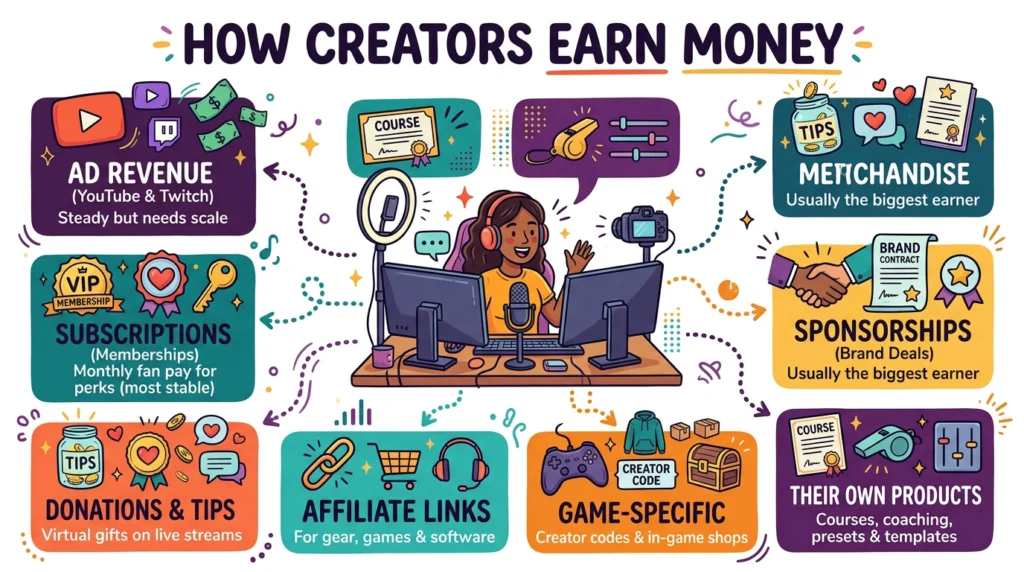
Creators earn from:
- Ad revenue (YouTube, and Twitch to a lesser extent). It’s steady but unpredictable and needs scale.
- Subscriptions and memberships. Fans pay monthly for perks. This is often the most stable income.
- Donations, tips and virtual gifts, especially popular on live streams.
- Sponsorships and brand deals, usually the biggest earner once you have a trusted audience.
- Affiliate links for gear, games and software.
- Merchandise, which works when your community feels like a tribe.
- Game-specific income, such as creator codes, in-game item shops, and publisher partnerships.
- Their own products: courses, coaching, presets, templates, even their own games.
How people lose
(money, time and sanity)
- Buying gear too early. A $3,000 setup doesn’t give you talent or an audience. Many creators overspend before they’ve proven the idea works.
- Chasing trends instead of building identity. Jumping on every viral game leads to a channel with no soul and no loyal viewers.
- Platform dependence. One ban or policy change and the income is gone.
- Ignoring contracts. Bad deals with agencies, orgs or sponsors have wrecked plenty of careers. Read everything.
- Burnout. The silent killer. Output goes up, joy goes down, and eventually quitting feels like relief.
- Gambling-style traps. Loot boxes, gacha pulls and skin betting have drained a lot of wallets, and some young people have gotten into real trouble.
- No Plan B. Pro careers are short and creator income is volatile. Having a skill outside the game matters.
- Comparing yourself to the top 1%. You only see the survivors, never the thousands who quietly quit.
What people spend on
Players spend on:
- Hardware: PCs, consoles, phones, controllers, headsets, monitors
- Games themselves, plus subscriptions like Game Pass-style services
- In-game purchases: skins, battle passes, currency (a massive revenue source in free-to-play)
- Internet and electricity, which people forget
- Esports tickets, merchandise and collectibles
Creators spend on:
- Camera, microphone, lighting and capture gear
- Editing software and subscriptions
- Editors, designers and managers as they grow
- Ads and promotion, sometimes
- Travel to events and conventions
The tech behind it all
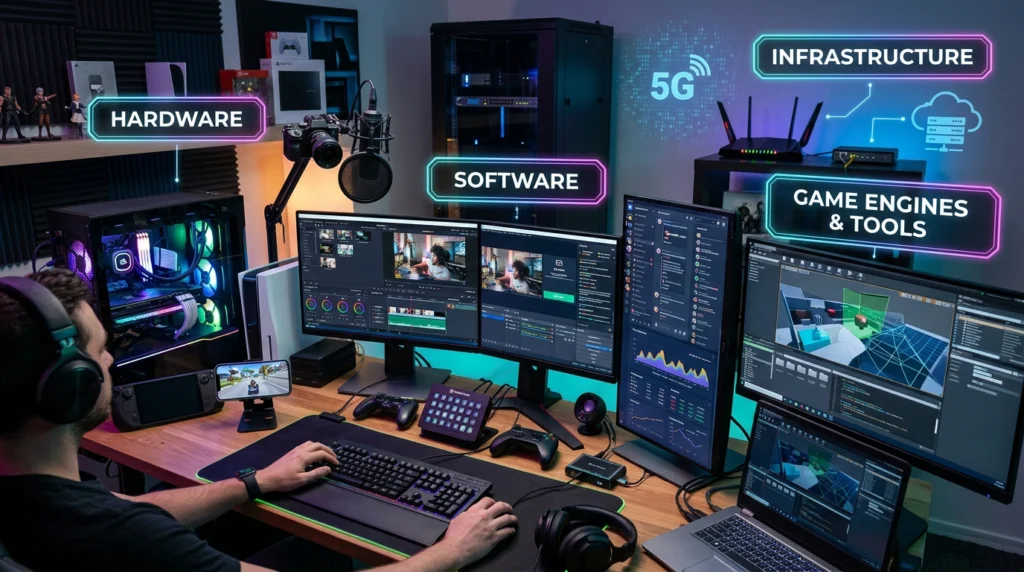
Hardware
- Gaming PCs with powerful GPUs, plus consoles and increasingly capable handhelds
- Smartphones that now run serious games
- Capture cards, mirrorless cameras, quality microphones, streaming decks
Software
- Streaming tools like OBS and Streamlabs
- Editors such as DaVinci Resolve, Premiere Pro and CapCut
- Voice and community platforms like Discord
- Analytics dashboards to understand what’s working
Game engines and tools
- Unreal Engine and Unity power a huge share of games, and Godot is popular with indie developers.
Infrastructure
- Faster broadband, 5G and cloud servers, which make low-latency online play and cloud gaming possible.
AI
This is the new frontier. Creators are using AI to:
- Auto-clip highlights from long streams
- Generate captions, subtitles and translations (a huge boost for reaching global audiences)
- Brainstorm titles, scripts and thumbnails
- Clean up audio and remove noise
Studios are also experimenting with AI for NPC behavior, art and testing. The debate is heated: it saves time, but many creators and players worry about originality, jobs and quality. My view is that AI works best as a helper, not a replacement for your voice. Audiences can smell generic content from a mile away.
VR/AR
Still a niche, but it keeps growing slowly, and it’s worth watching.
So where is this all going?
My predictions, take them with a grain of salt:
- Smaller, loyal communities will beat huge, shallow audiences. One thousand people who really care about you is worth more than 100,000 who scroll past.
- Creators will diversify. Multiple platforms, multiple income streams, and owned channels like email lists and Discord servers.
- Esports will get leaner and smarter, with a focus on sustainable business models.
- Regions outside the traditional Western and East Asian hubs will rise, powered by mobile and young populations.
- Authenticity will become the premium product as AI content floods everything.
Final thoughts
Gaming and content creation grew from a hobby into a global culture and industry, and like any boom, it produced both stories of life-changing success and stories of burnout and broken promises. The truth sits in the middle. It’s real, it’s creative, and it’s volatile.
If you love it, there’s room for you, as long as you go in with open eyes, a plan, and a bit of patience.
So what’s your take? Are you playing, streaming, watching or building? Drop a comment and tell me where you fit in this crazy ecosystem.
