
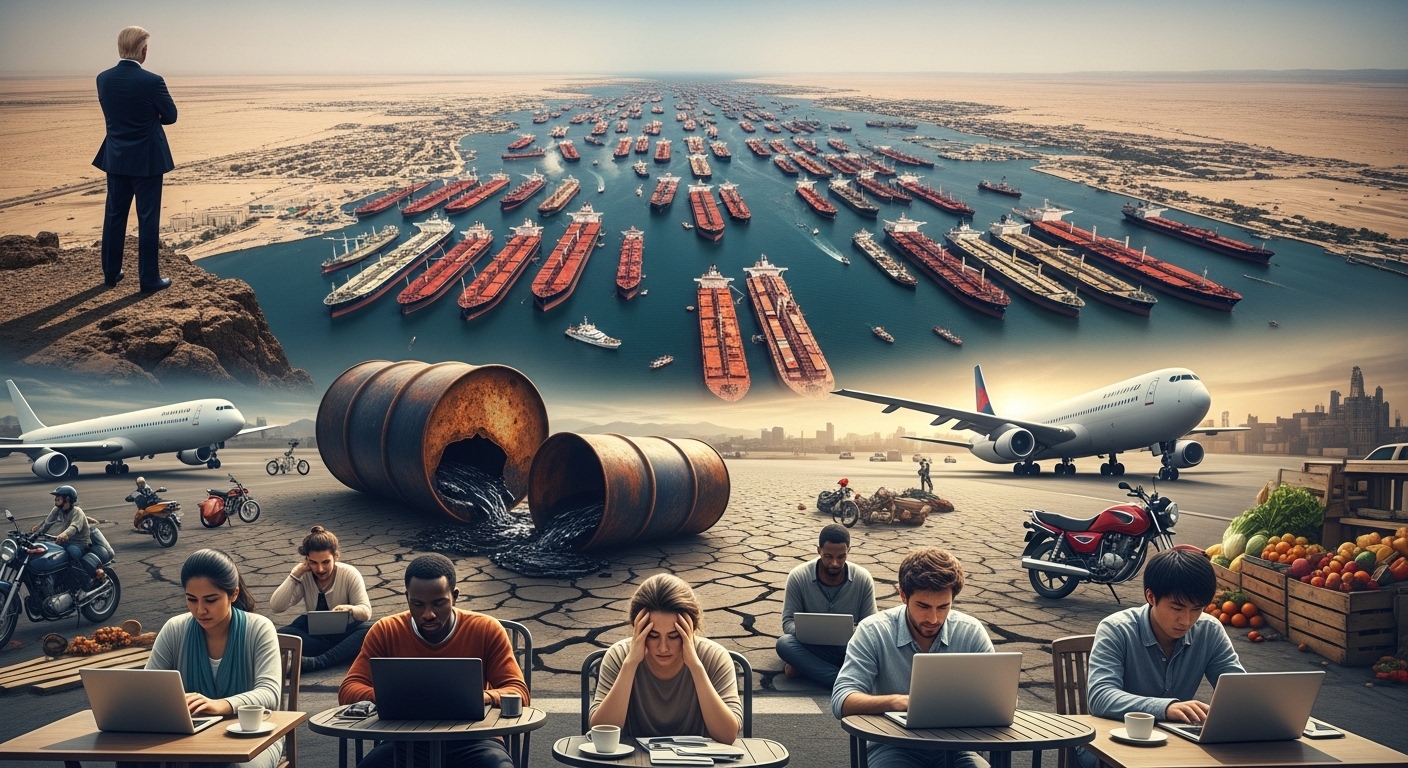
Your Budget, Their War
Let’s be honest. Most of us didn’t become digital nomads to follow oil markets.
We packed up our laptops and our lives because we wanted freedom the freedom to work from a beach in Bali, a cafe in Lisbon, a rooftop in Nairobi, or a co-working space in Chiang Mai. We were done with commutes. Done with grey office walls. Done with paying London or New York rent on a salary that barely kept up.
But here’s the part nobody puts in the Instagram caption: when a war breaks out 5,000 kilometres away in the Persian Gulf, it finds you anyway. Not through missiles or soldiers through your electricity bill, your tuk-tuk fare, your grocery receipt, and the slowly climbing price of the flight you’re about to book.
That’s exactly what’s happening right now. On 28 February 2026, the United States and Israel launched strikes on Iran. Iran retaliated and within hours, the Strait of Hormuz, the narrow waterway through which 20% of the world’s daily oil supply passes, ground to a near halt. Over 150 tankers sat anchored outside it. Brent crude surged past $120 per barrel. Shipping insurance premiums went up four to five times overnight. And a ripple of financial consequences began spreading across the globe landing, eventually, on the laptops and budgets of 35 million digital nomads worldwide.
the Big Picture: What Actually Happened?

Effective tanker traffic through the Strait of Hormuz as of early March 2026 down from 20 million barrels per day after Iran declared the strait 'closed' to Western-affiliated ships.
Peak Brent crude price reached in March 2026, up from $73/bbl before the February 28 strikes a 73% price surge in under two weeks.
European natural gas prices rose 63% in a single week the largest weekly gain since Russia invaded Ukraine in 2022. Asian LNG prices hit $23.40/MMBtu.
The increase in war-risk shipping insurance premiums, making commercial transit economically unviable for most operators even where the strait technically remains open.
To understand why this affects your daily life as a nomad, you need to know one thing: oil is not just what goes in a car. Oil is the hidden cost inside almost everything electricity generation, food transport, flight fuel, manufacturing, heating. When oil prices spike by 70% in two weeks, the price of nearly everything that relies on energy to produce, transport, or store starts to creep upward. It happens at different speeds in different countries. But it happens everywhere.
The scale of this crisis is genuinely historic. Qatar declared force majeure on its LNG exports. Kuwait cut production. Saudi Arabia’s Ras Tanura refinery one of the world’s largest was forced to curtail operations. The IEA released 400 million barrels from emergency reserves in its largest-ever coordinated drawdown. The US Congress opened formal hearings. Goldman Sachs and UBS warned that if the disruption extends through Q2 2026, global headline inflation could rise 0.7 – 0.8 percentage points and shave 0.4 percentage points off global GDP growth effectively wiping out the gains of the entire post 2024 recovery.
Now let’s get specific about what this means for you, depending on where you are.
Asia Pacific: The Frontline of the Shock
If you’re based anywhere in Asia right now, you’re sitting in the epicenter of this crisis at least in terms of energy dependency.
84% of the crude oil that flows through the Strait of Hormuz is destined for Asian markets. China, India, Japan, and South Korea alone account for nearly 70% of all Hormuz shipments. In other words, when the Strait closes, Asia feels it first, fastest, and hardest.
Thailand (Chiang Mai, Bangkok, Koh Samui)
Thailand imports roughly 85% of its energy. Fuel prices were already moving upward in early March, with pump prices expected to climb significantly if the crisis persists. Here’s what that means practically: your scooter rental just got more expensive. Your Grab ride just got more expensive. The air conditioning in your co-working space is powered by electricity generated partly by fuel, so expect co-working costs to inch upward too. The good news? Thailand’s baht has historically weakened in energy crises, which boosts your USD or EUR purchasing power on the ground. Chiang Mai’s famous affordability you can live well here for under $1,200/month is under pressure but not yet broken.
Indonesia (Bali, Canggu, Ubud)
Bali was already experiencing a cost-of-living surge driven by digital nomad popularity rents in Canggu and Uluwatu had risen 15%+ in the past year. The oil shock adds another layer. Indonesia subsidises fuel for its citizens, which means the government bears the cost of global price spikes rather than passing them directly to consumers but that subsidy policy creates fiscal pressure that eventually feeds into other costs. For nomads on Bali, the practical impact is subtler: expect gradual price rises in transport, restaurant food that relies on fuel-dependent supply chains, and potentially in electricity if rolling blackouts return. The island’s appeal remains strong, but the $800 -$1,500/month budget that drew nomads here is looking tighter.
Vietnam (Da Nang, Ho Chi Minh City, Hanoi)
Vietnam is one of the most energy-import-dependent countries in Southeast Asia and has limited buffer against global fuel shocks. Da Nang, currently one of the most popular emerging nomad hubs affordable rent under $400, fast internet, beach access is feeling the pinch through higher local transport costs and rising food prices as the supply chain for imported goods becomes more expensive. Vietnam’s dong has been under pressure against the dollar, which again benefits USD earners. If you’re already here, stay and enjoy the currency advantage. If you’re planning a move, budget 10–15% higher on transport and food than 2025 estimates suggest.
India (Goa, Bangalore, Mumbai)
India is acutely exposed it sources a massive share of its crude oil from Gulf producers. The government faces the same dilemma as Sri Lanka, just at much larger scale: subsidies fuel and damage the fiscal deficit, or pass costs to consumers and trigger inflation that hits the poorest hardest. For nomads, India’s cost of living remains among the lowest in Asia but energy-intensive expenses like air conditioning, domestic flights, and intercity travel are already rising. The rupee is under depreciation pressure, which benefits foreign earners. Goa remains one of the world’s great nomad value propositions; the oil crisis adds friction, not a fundamental reason to leave.
Most exposed region globally to the Hormuz crisis due to oil import dependency. Transport, food, and electricity costs rising across the board.
Currency weakening in many markets = purchasing power boost for USD/EUR earners.
Core affordability remains intact but budgets need a 10–20% upward revision. Best value still: Chiang Mai, Da Nang, Goa, Yogyakarta.
Asia Pacific
The Nomad VerdictMiddle East & Africa: The Complicated Neighbourhood
The Middle East and Africa present the most varied picture for digital nomads. This is a region of dramatic contrasts from Dubai’s oil-fuelled abundance to Nairobi’s grid instability to Cape Town’s load-shedding marathons. The oil crisis hits each of these very differently.
The UAE (Dubai, Abu Dhabi)
Counterintuitively, the UAE is one of the few places in the world where the oil crisis creates a kind of economic opportunity. As an oil producer, the UAE benefits from higher prices, its government coffers fill, infrastructure investment continues, and the dirham (pegged to the USD) remains rock-solid stable. Dubai’s co-working scene is world-class, and the government has actively marketed itself as a remote work and entrepreneur hub. The catch for nomads: Dubai was never affordable to begin with, and as a global financial hub it attracts capital and talent regardless of crises. If you can afford Dubai, the oil crisis doesn’t hurt your budget here it arguably helps, as regional instability makes Dubai look even more like a stable haven for mobile professionals.
Morocco (Marrakech, Essaouira, Taghazout)
Morocco is one of the most underrated nomad destinations on earth, and the oil crisis creates an interesting dynamic here. Morocco is an oil importer it relies on fossil fuel imports for most of its energy. Higher global prices translate into higher fuel and electricity costs domestically. But the dirham is relatively stable, the country has been investing heavily in renewable energy (Noor Solar is one of the world’s largest solar complexes), and Morocco’s appeal the culture, the food, the Atlantic surf breaks, the medina architecture is unchanged by distant geopolitics. Budget nomads living on $1,000–$1,400/month in Marrakech should factor in a 10–15% increase on energy-adjacent costs. The lifestyle trade off remains extraordinarily favourable.
Kenya & East Africa (Nairobi, Mombasa)
Nairobi has emerged as one of Africa’s most exciting digital nomad hubs, tech-forward, English-speaking, with a fast-growing startup ecosystem and a co-working culture that punches well above its weight. But Kenya is deeply vulnerable to oil shocks. The country imports virtually all its petroleum, and every price spike translates directly into higher fuel costs for the matatu minibuses that most Nairobians rely on, higher food prices (Kenya’s agricultural sector is highly fuel-dependent), and higher electricity bills all in a country where many people are already stretched thin. For nomads earning in hard currencies and spending in Kenyan shillings, the currency advantage is real. But be aware: rapid inflation in a developing economy can destabilise the social and political environment in ways that affect daily safety and convenience.
South Africa (Cape Town, Johannesburg)
Europe is in a paradoxical position. It doesn’t import much Middle Eastern oil directly. But it does import enormous quantities of Qatari LNG liquefied natural gas that travels through the same Strait of Hormuz now effectively closed to commercial shipping. And Europe entered 2026 with gas storage levels at 46 billion cubic metres dramatically lower than the 77 bcm it held in 2024.
The result? European natural gas prices surged 63% in a single week following the strikes. That’s the largest weekly gas price increase since Russia invaded Ukraine in 2022. And unlike oil, gas is much harder to reroute you can’t easily redirect an LNG tanker the way you can redirect a crude oil shipment.
UAE: Counterintuitively benefits oil producer with stable currency and infrastructure.
Morocco: Oil importer but strong renewables pipeline; costs rising 10–15% on energy-adjacent items.
Kenya/East Africa: Most exposed in region; currency advantage for USD earners.
South Africa: Grid stability improving but oil costs add pressure; cowork with backup power.
Best value still: Marrakech, Nairobi (with caution), Taghazout.
Middle East & Africa
The Nomad VerdictEurope: Not Oil-Dependent, But Not Safe Either
Europe is in a paradoxical position. It doesn’t import much Middle Eastern oil directly. But it does import enormous quantities of Qatari LNG liquefied natural gas that travels through the same Strait of Hormuz now effectively closed to commercial shipping. And Europe entered 2026 with gas storage levels at 46 billion cubic metres dramatically lower than the 77 bcm it held in 2024.
The result? European natural gas prices surged 63% in a single week following the strikes. That’s the largest weekly gas price increase since Russia invaded Ukraine in 2022. And unlike oil, gas is much harder to reroute you can’t easily redirect an LNG tanker the way you can redirect a crude oil shipment.
Portugal (Lisbon, Porto, the Algarve)
Lisbon has become one of Europe’s most popular nomad destinations part Atlantic sunshine, part affordable (by Western standards) living, part time-zone convenience for US clients. The oil crisis affects Portugal primarily through energy prices and inflation. Electricity bills already a significant expense for Lisbon apartment renters are set to climb further as European gas prices surge. The good news: Portugal has been investing heavily in renewable energy (hydro, wind, solar), giving it more insulation than gas-heavy economies like Germany or Italy. Lisbon’s appeal endures. Studios in central areas now run €900 – €1,200/month; factor in 10 – 15% higher utility bills and slightly elevated grocery costs for the duration of the crisis.
Georgia (Tbilisi)
Tbilisi has become one of the most talked-about under the radar nomad destinations in recent years. Fast Wi-Fi. Visa-free for most nationalities. Wine country on the doorstep. Living well for under $1,000/month. Georgia imports oil and gas from Azerbaijan and Russia its exposure to the Hormuz crisis is indirect rather than direct, which is actually an advantage in the current environment. While European neighbors scramble for alternative LNG sources, Georgia’s energy mix and regional supply relationships provide more stability. If you haven’t considered Tbilisi yet, now with much of Western Europe facing higher energy costs is actually a compelling moment to look at it seriously.
Germany, Netherlands, Spain (Western & Northern Europe)
Western Europe is the most exposed part of Europe to the LNG crisis specifically. Germany and the Netherlands, which shifted heavily to LNG after cutting Russian pipeline gas, are now competing with Asian buyers for the same limited spot market cargoes. Industrial energy costs are rising, feeding into higher prices for almost everything produced or transported in these economies. For nomads based in Berlin, Amsterdam, or Barcelona already high-cost cities this is an extra squeeze on a budget that was never cheap to begin with. It’s also an argument for looking at Eastern Europe: cities like Budimpesta, Sofia, or Bratislava offer dramatically better value and are less directly exposed to the LNG price surge.
Eastern Europe (Bulgaria, Romania, Hungary)
Eastern Europe is having a moment, and the energy crisis might actually accelerate it. Cities like Sofia (Bulgaria), Cluj-Napoca (Romania), and Krakow (Poland) offer fast internet, walkable city centres, strong cafe and co-working cultures, EU legal frameworks, and monthly living costs of €800 – €1,200 roughly half of what you’d pay in Lisbon or Barcelona. Their energy mix leans more toward domestic sources and less toward Gulf LNG, giving them relative insulation from the Hormuz crisis. If you’re a nomad currently based in Western Europe and watching your energy bills climb, Eastern Europe is your pressure valve.
LNG prices surging 63% in a week biggest hit is gas-dependent Western/Northern Europe.
Portugal relatively insulated thanks to renewables investment.
Georgia (Tbilisi) is a standout indirect exposure, low cost, high value.
Eastern Europe: the smart pivot lower cost, less LNG dependency.
Best value for money: Tbilisi, Sofia, Cluj-Napoca, Krakow, Budapest.
Europe
The Nomad VerdictWhat Every Nomad Feels, Everywhere
- Flights Are Getting More Expensive – Fast
Jet fuel accounts for roughly 25–30% of an airline’s operating costs. When Brent crude surges from $73 to $126 per barrel, airlines face an enormous cost increase that they have no choice but to pass on through higher fares and fuel surcharges. The Hormuz disruption also affects 30% of Europe’s jet fuel supply directly. Flight prices were already running high in early 2026; by mid-March, surcharges were appearing on bookings across multiple carriers. If you’re planning to relocate destinations in the next two to three months, booking now is strongly advisable. Waiting is likely to cost significantly more.
- Your Monthly Budget Needs a 15–20% Upward Revision
The average digital nomad budget in 2026 runs between $1,200 and $2,500 per month depending on region and lifestyle. The oil crisis doesn’t blow that up but it does add friction. Transport (scooter fuel, tuk-tuks, ride apps), electricity (especially in hot climates where air conditioning is non-negotiable), food (transport and packaging costs are fuel dependent), and accommodation utility bills are all rising. The pragmatic advice: add 15 – 20% to your transport and utility budget lines for the next two to three months and adjust as the situation clarifies.
- Power Reliability Is Under Pressure in Developing Countries
In countries where grid electricity is generated significantly from fuel oil including many in Southeast Asia, South Asia, and Africa power reliability is directly linked to fuel availability and cost. Higher fuel costs mean either higher electricity tariffs or, in countries without fiscal space to absorb the difference, rolling blackouts. Nomads working from home or budget co-working spaces are most exposed. The answer is the same as it’s always been: always have a backup internet solution (mobile hotspot), always confirm your co-working space has generator backup, and in high-risk countries, consider serviced apartments with reliable backup power included in the rent.
- The Foreign Currency Advantage Is Real But Bittersweet
Here’s the part that nomads earning in strong currencies need to acknowledge honestly. In most of the countries hardest hit by the oil crisis the developing economies of Asia, Africa, and the Middle East local currencies are weakening under dollar demand from oil importers. That means your USD, EUR, or GBP goes further on the ground. Your $2,000/month income buys more rupees, baht, shillings, or rupiah than it did three months ago. You’re partially insulated and in some cases actually better off in real terms while local residents face a painful cost-of-living increase. That asymmetry is real, and the most thoughtful nomads are aware of it. Spending locally, tipping generously, and supporting local businesses matters more, not less, in periods of economic stress.
8 Practical Tips for Nomads Navigating the Oil Crisis
Book Your Next Flight Now
Lock In Accommodation with Inclusive Utilities
Prioritize Coworking Spaces with Backup Power
Always Carry a Mobile Hotspot
Adjust Your Budget Model for 15 - 20% Transport and Utility Increase
Consider Eastern Europe or Georgia as a Pressure-Relief Valve
Monitor Your Country's IMF and Currency Situation
Build an Emergency Relocation Fund
Is This a Blip or a New Reality?
Let’s zoom out for a second and ask the uncomfortable question: is this a temporary disruption, or is it revealing something structural about the world we’re nomading through?
Honestly? It’s both.
In the short term, the Strait of Hormuz situation is showing signs of partial resolution. As of March 13, Iran approved passage of a Turkish ship. Indian-flagged gas carriers and a Saudi tanker have been allowed through. Saudi Arabia and the UAE are routing oil through alternative pipelines, albeit at reduced capacity. The IEA’s reserve release is buying time. Markets are volatile but not in free-fall.
But in the structural sense, the 2026 crisis has confirmed something that energy analysts have been warning about for decades: the world’s entire energy supply chain runs through a 34-kilometre-wide chokepoint that any determined regional power can threaten. There is no quick fix for that vulnerability alternative pipeline capacity covers only about 17% of normal Hormuz flows, and it would take years and hundreds of billions of dollars to build meaningful resilience.
For digital nomads specifically, the lesson is clear. The lifestyle works best when the global infrastructure it depends on cheap flights, stable electricity, affordable local costs — is itself stable. When that infrastructure is disrupted, the nomad lifestyle doesn’t collapse, but it requires adaptation. The nomads who navigate this best are those who build financial resilience (emergency funds, diversified income, owned audience), geographic flexibility (willingness to move quickly), and local knowledge (understanding their host country’s specific vulnerabilities) into their operating model.
Keep Moving, Keep Adapting
The 2026 oil crisis is not the end of the digital nomad lifestyle. Not even close.
But it is a test of your financial resilience, your geographic flexibility, and your ability to read global events and adapt your plans accordingly. The nomads who thrive through this will be those who update their budgets, book flights before surcharges compound, choose bases with reliable power infrastructure, and hold enough of an emergency fund to move quickly if a developing economy starts to wobble.
The rest of it? The sunsets are still there. The co-working scenes are still buzzing. The food is still incredible. The community of people who have chosen this way of life is still one of the most interesting, resourceful, and adaptable communities on the planet.
A refinery got hit in the Persian Gulf. Your scooter fuel costs a little more. Your electricity bill is slightly higher. But you’re still working from a place most people only dream about visiting.
