Not long ago, a ‘content creator’ was a job title that required explanation at dinner parties. Today, it is one of the most aspirational career paths on the planet and one of the most economically significant.
What began as a wave of bloggers, YouTubers, and Instagram photographers sharing passion projects has evolved into a structured, venture-backed, multi-hundred-billion-dollar global industry. The creator economy in 2026 is not a trend. It is infrastructure. And understanding it is no longer optional for any brand, marketer, or media professional who wants to stay relevant.
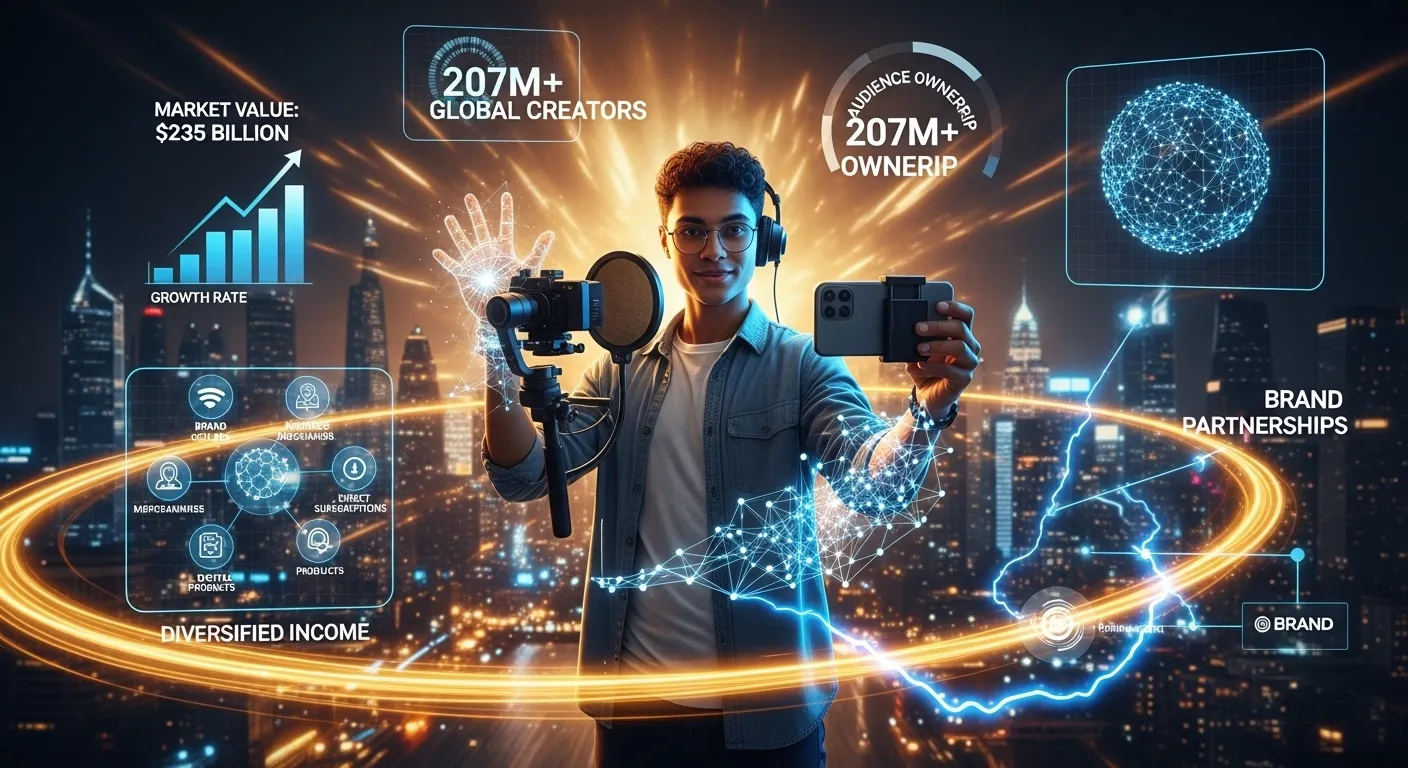
The creator economy’s current market value in 2026, growing at a 22.5% CAGR and on track to surpass $1 trillion by the early 2030s. (Research Nester / Social Native)
Active content creators worldwide. In the US alone, 162 million people identify as creators with over 45 million working professionally. (DemandSage)
Projected influencer marketing spend in the US in 2026, up from $32.5 billion in 2025, A 35.6% year-over-year increase. (Mordor Intelligence)
The average revenue growth that full-time creators are projecting for themselves in 2026, driven by income diversification strategies.
These are not aspirational projections. They are measurements of a structural shift in how the world produces, distributes, and consumes media. The creator economy has grown by 19% since 2024 alone outpacing most traditional marketing channels and many legacy media businesses.
From Hobby to Industry: What Changed?
The creator economy did not emerge overnight. It was built in layers. Each technological shift adding a new stratum of possibility for ordinary people to build audiences and monetize their expertise, personality, and creativity.
The blog era of the early 2000s gave writers a publishing platform without gatekeepers. YouTube, launched in 2005, gave video creators distribution without TV networks. Instagram and Twitter gave rise to the visual and conversational influencer. TikTok, arriving in the West around 2019, turbocharged the whole ecosystem by combining discovery, virality, and monetisation in a single addictive scroll.
But what has made 2025 and 2026 genuinely different is maturity. The creator economy has stopped being a space defined by viral moments and started operating like a real industry — with business infrastructure, venture capital investment, professional tools, and measurable ROI.
The creator economy is no longer a niche corner of social media. It has evolved into a global economic engine.
NeoReach
Creator economy startups raised over $767 million globally between 2023 and 2024 a 49% year-over-year increase. In 2025, M&A deal volume in the space rose 17.4%, with 81 transactions completed, including landmark deals across software, talent management, and media properties. North America still dominates with 71% of transactions, but Asia-Pacific is the fastest-growing region, with a projected CAGR exceeding 20% through 2032, driven by mobile-first content creation across India, Indonesia, and Southeast Asia.
Who Is a Creator in 2026?
The word ‘creator’ has fractured into multiple archetypes, and understanding the distinctions matters enormously for brands looking to partner effectively.
The Nano-Creator (1K – 10K followers)
Perhaps the most underestimated force in the creator economy. Nano-creators on TikTok now account for 57% of all creator activity on the platform. Their engagement rates are significantly higher than those of mega-influencers, their audiences trust them deeply, and their cost-per-partnership is dramatically lower. A budget that funds a single post from a macro-influencer can fund an entire campaign with multiple nano-creators reaching different, highly targeted communities.
The Nano-Creator (1K – 10K followers)
Perhaps the most underestimated force in the creator economy. Nano-creators on TikTok now account for 57% of all creator activity on the platform. Their engagement rates are significantly higher than those of mega-influencers, their audiences trust them deeply, and their cost-per-partnership is dramatically lower. A budget that funds a single post from a macro-influencer can fund an entire campaign with multiple nano-creators reaching different, highly targeted communities.
The Professional Creator (100K+ followers)
This tier has professionalised dramatically. Top earners in 2026 maintain seven or more revenue streams and earn an average of $75,000 more than creators with a single income source. Many have built what analysts are calling ‘creator loyalty infrastructure’ owned communities, product lines, live events, and newsletter audiences that operate independently of any single platform’s algorithm
The Creator-Entrepreneur
The newest and fastest-growing archetype. These individuals think less like influencers and more like media companies launching product brands, acquiring smaller creators, licensing content, and raising venture capital. In 2026, VC firms like Slow Ventures are backing creator-founded businesses with the same rigour applied to tech startups.
What Brands Get Wrong - And How to Get It Right
For brands, the creator economy offers extraordinary leverage but only when approached strategically. The data reveals several persistent mistakes that prevent brands from extracting full value from creator partnerships.
- Brand partnerships & sponsored content: 59% of creator revenue comes from sponsored content, making it the dominant income stream. Nearly 69% of creators cite brand deals as their primary source of income.
- Platform payouts: Ad revenue sharing accounts for 24.4% of creator income across YouTube, TikTok, and Meta’s platforms.
- Affiliate marketing & UGC licensing: These combined categories now represent 21.2% of creator income a significant shift toward self-owned revenue that doesn’t depend on brand deal availability.
- Subscriptions & memberships: Platforms like Patreon, Substack, and beehive are enabling creators to build predictable recurring revenue. A newsletter list of 15,000 subscribers on the right platform can generate $6,000–$8,000 monthly.
- Digital products & courses: Creators who understand value-based pricing, charging for the transformation their content delivers, not just the production cost are building highly scalable product businesses.
- Live events & IRL activations: 2026 is seeing a surge in in-person creator events that drive direct sales while building deeper community bonds.
The income distribution, however, reveals a significant divide. 48.7% of US creators earn under $10,000 annually, while 45.6% earn between $10,000 and $100,000, and just 5.7% earn over $100,000. The critical threshold appears to be around $15,000 in annual revenue creators who cross this barrier tend to accelerate rapidly, while those below it often struggle to sustain full-time creative work.
Why the Next Generation Is Redefining Media
No analysis of the creator economy is complete without understanding its relationship with Gen Z the generation that has grown up inside it.
56% of Gen Z and 43% of Millennials now consider creator content more relevant and trustworthy than television or film. Over 41% of Gen Z users use social platforms as their primary search engine, discovering products, services, and news through creators rather than traditional media outlets.
This is not a passing preference. It is a generational rewiring of media consumption habits and it has profound implications for brands. Traditional advertising built around television spots and editorial placements is becoming increasingly invisible to the world’s largest consumer generation. Creator content is not.
Gen Z creators also begin earlier and monetize more quickly than any previous generation. Many are building audiences and businesses before the age of 20, with the native digital fluency that comes from having grown up entirely in the social media era.
AI and the Creator Economy: Opportunity and Tension
Artificial intelligence is reshaping the creator economy from two directions simultaneously as a productivity tool and as a disruptive force.
On the productivity side, 84% of creators now use AI-powered tools in their workflows. Top earners use AI twice as frequently as lower earners, achieving 2–5 times higher engagement as a result. AI is being applied to content ideation, video editing, caption generation, audience analysis, and monetisation optimisation. 68% of creators plan to expand their AI usage further in 2026 and beyond.
On the disruptive side, a consumer backlash is building. The percentage of people who view generative AI as a negative disruptor in the creator economy has nearly doubled from 18% to 32% since late 2023. Consumer enthusiasm for AI-generated creator content has dropped from 60% to just 26% over the same period. 52% of consumers are concerned about brands posting AI-generated content without disclosure.
The message from audiences is clear: they want AI to make creators more efficient, not to replace them. Authenticity, personality, and human connection remain the core value of creator content and that is something no algorithm can replicate.
The ones who succeed will use AI to speed up the work but still trust their own judgment — staying in the driver's seat.
Influencer Marketing Factory
What Brands Get Wrong and How to Get It Right
For brands, the creator economy offers extraordinary leverage but only when approached strategically. The data reveals several persistent mistakes that prevent brands from extracting full value from creator partnerships
- Chasing followers over alignment: Only 27% of creator content ties strongly to the brand it promotes, largely because brands still prioritise reach over relevance. Engagement quality, audience alignment, and sentiment should matter more than follower counts.
- One-off campaigns vs. ongoing partnerships: Creator content compounds in value over time. Always-on creator programs where creators become genuine brand advocates across multiple touchpoints consistently outperform single sponsored posts.
- Ignoring the measurement challenge: 79% of marketers cite ROI measurement as their biggest challenge in influencer marketing. Brands that invest in proper attribution and tracking infrastructure are seeing massive competitive advantages.
- Over-briefing creators: The Kantar 2026 Marketing Trends Report warns that over-directing creators kills the very authenticity that makes their content effective. The skill is setting clear guardrails while genuinely letting creators do what they do best.
- Missing nano and micro creators: The economics of smaller creators are compelling. A single macro-influencer budget can fund 10–20 nano-creator partnerships, often delivering superior aggregate engagement with more targeted audiences.
71% of consumers make a purchase within days of seeing creator content on Meta’s platforms. That conversion speed is nearly impossible to replicate with traditional advertising. But it requires genuine partnership not a brand message awkwardly inserted into someone else’s creative voice.
Where the Creator Economy Goes Next?
The trajectory of the creator economy points toward one destination: further consolidation, deeper professionalization, and integration into every layer of commerce and media.
The creator economy is projected to surpass $480 billion by 2027 (Goldman Sachs) and could reach $1.18 trillion by 2032 (SNS Insider). Creator storefronts are becoming mainstream e-commerce destinations. Creator content is moving to connected TV and streaming platforms. Podcasting where 67% of global listeners have made a purchase directly because of a host is emerging as the highest-trust creator format.
Platform consolidation is accelerating. Creators are moving their audiences off social media and into owned channels email lists, private communities, apps, and direct-to-fan platforms that protect them from algorithm changes and platform risk. The brands that recognise this shift and meet creators in their owned spaces will be the ones that build the deepest, most commercially valuable relationships.
And at the very top of the creator tier, a new class of media mogul is emerging creators building companies, acquiring talent, launching product lines, and raising capital with the same ambition that once defined Hollywood studios. The creator economy’s next chapter is not about more creators. It is about better ones, building bigger, more durable businesses.
Final Thoughts
The creator economy boom is not a moment. It is a movement and it is still in its early chapters. With 207 million creators worldwide, $235 billion in market value, and a growth rate that outpaces almost every traditional industry, the creator economy has permanently changed the relationship between audiences, content, and commerce.
For creators, the opportunity has never been greater but so has the competition. The creators who will win are those who think like entrepreneurs, diversify their income, own their audience relationships, and use AI as a tool without losing the human authenticity that makes their content worth watching.
For brands, the message is equally direct: the creator economy is not optional. It is the present and future of marketing. The question is not whether to invest it is how to invest wisely, sustainably, and in a way that respects both the creator’s voice and the audience’s intelligence.
The economy of creation has arrived. Those who understand it will shape what comes next.
